Request Tracker 2
How it works
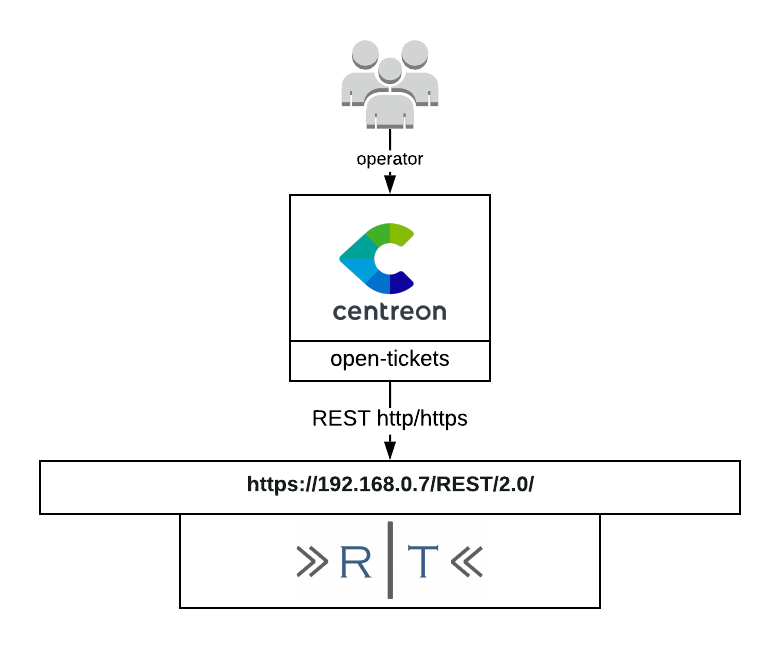
The Request Tracker 2 provider uses the REST API of Request Tracker to retrieve data in order to open a ticket.
Compatibility
This connector requires at least the version 2.0 of the REST API of Request Tracker
Feature information
| Open ticket | Close ticket (from Centreon to Request Tracker) | Handle custom fields |
|---|---|---|
| ✓ | ✘ | ✓ |
Requirements
Before going any further, make sure that you correctly setup centreon-open-ticket into your Centreon instance
Our provider requires the following parameters:
| Parameter | Example of value |
|---|---|
| Address | 192.168.0.7 |
| token | xxxxxxxxxxxxxxxxxxxxxxxxxxxx |
| Path | /REST/2.0/ |
| Timeout | 60 |
Network flow
| Source | Destination | Protocol/Port |
|---|---|---|
| Centreon central server | Request Tracker | TCP/443 (https) or TCP/80 (http) |
Account
You need the following information:
- Address
- Token
The aforementioned account must be able open a ticket through the /ticket API endpoint.
The connector will also try to access the following API endpoints depending on the configuration of your open ticket rule:
- /queues/all
- /customfields
- /customfield
Some test commands that you can run from your Centreon central server are available in the Test commands section.
Retrieved data
This open ticket connector can retrieve the following information from your Request Tracker server:
- Custom fields
- Queues
If you need more information regarding retrieved data from an open ticket connector, please read the retrieved data chapter from the Open Ticket global documentation.
Additional data
This open ticket connector can also send the following information when opening a ticket:
- Requestor
- Cc
Those information are not retrieved from Request Tracker. They are configured in your open ticket rule as custom lists.
Test commands
The curl commands listed below must be run from your central server. You need to replace all elements between <>. For example <rt_address> may be replaced with my_rt.local.
Get queues
curl 'https://<rt_address>/REST/2.0/queues/all?fields=id,Name&per_page=100&page=1' \
--header 'Content-Type: application/json' \
--header 'Authorization: token <token>' \
Get custom fields
List custom fields based on the filter:
curl 'https://<rt_address>/REST/2.0/customfields?fields=Name' \
--header 'Content-Type: application/json' \
--header 'Authorization: token <token>' \
--data '[{"field": "Name","operator":"LIKE","value":"<filter_value>"}]'
Get custom field information from previous result:
curl 'https://<rt_address>/REST/2.0/customfield/<customfield_id>' \
--header 'Content-Type: application/json' \
--header 'Authorization: token <token>'
Open a ticket
Keep in mind that the data in the command below is just an example and your Request Tracker server may ask you to add mandatory data.
curl --location 'https://<rt_address>/REST/2.0//Ticket' \
--header 'Content-Type: application/json' \
--header 'Authorization: token <token>' \
--data '{
  "Queue": "queue_name",
  "Subject":"this is a test ticket",
  "Content":"Believe it or not, but it is just a test"
}'